
How to Get Court Records
Court Administration in Martin County keeps the District Court case files. It issues certified copies. It also answers questions about records you cannot pull up remotely. For eligible cases and documents, begin with Minnesota Court Records Online, or MCRO. It shows a case online. It does not hand you a certified court record. For a broader public-access search, MPA Courthouse View is available at any Minnesota district courthouse.
- Identify the court file number, or collect the known party, case-type, county, and date information before requesting a Martin County record.
- Check MCRO for a public Register of Actions, hearing history, judgment detail, or available document. A Martin County case search can help locate a file number first.
- For material not shown remotely, use the courthouse public-access route or contact Martin County Court Administration by phone at 507-432-7003.
- Submit the statewide copy-request form in person, by mail, or through the delivery method the court approves. The form supports U.S. Mail, pickup, fax, email, and a prepaid FedEx or UPS label.
- Specify plain, certified, or certified-and-exemplified copies, then confirm payment and delivery arrangements with the court for a complex, offsite, or confidential request.
Filing something new is a different task entirely. Martin County residents starting a case can use Minnesota eFile and eServe, or an approved paper route. Asking for a record that the court has already filed and processed is a records request, not a filing.
Martin County Court Record Access Routes
Three routes exist, and each fits a different need. MCRO can display a public case summary, the ROA, and selected documents. MPA Courthouse View is the in-person option for eligible material that MCRO does not display. For certified copies, older or offsite files, and restricted-record questions, go through Martin County Court Administration. The statewide Minnesota copy-request help page lays out that process and explains the difference among plain, certified, and exemplified copies.
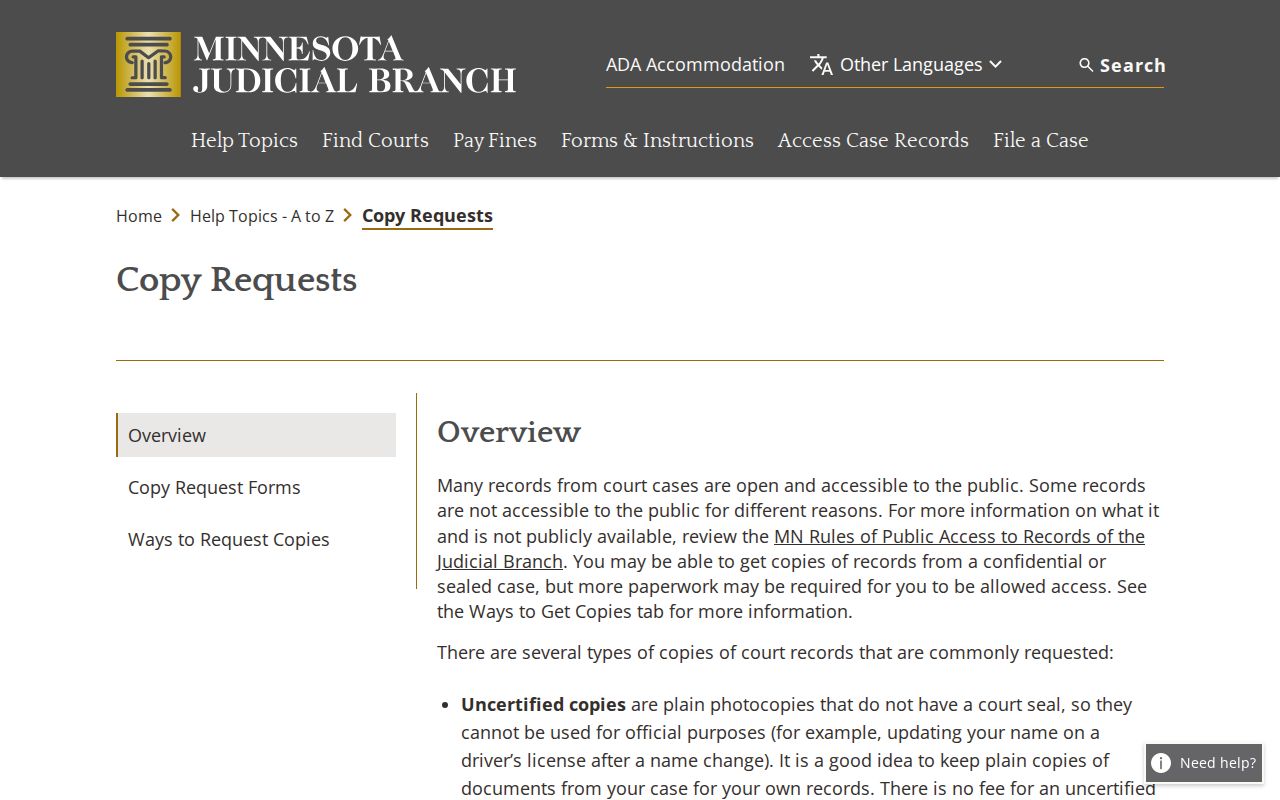
Mail and phone still work for anyone who cannot use the remote systems. No universal turnaround time is promised. The statewide help page notes that most in-person copies are ready the same day, though offsite records may take longer.
Types of Court Records
The Martin County District Court keeps records across all statewide court categories. Remote visibility varies. Case type, filing date, and document type each affect what you can see. The Register of Actions is the main chronological record. Separate access rules can govern individual documents, hearing data, financial entries, and judgment information.
- Case information and the Register of Actions for civil, criminal, traffic, family, probate, and related District Court matters.
- Public motions, orders, and other documents when the case type, date, and remote-access rule permit display.
- Hearings, case events, dispositions, and judicial-officer information shown in a public case detail.
- Judgment details, judgment parties, and satisfactions when the applicable record is public.
- Certified copies and case-management reports obtained through Court Administration rather than by printing an MCRO screen.
Conciliation Court is Minnesota's small-claims division inside the District Court system, not a separate Martin County courthouse. Federal files live in separate federal systems. A local connection to a party or event does not pull a federal case into an MCRO result.
Martin County Register of Actions
Minnesota's official docket term is the Register of Actions, or ROA. Minnesota Statutes section 485.07 lists the register of actions, judgment roll, judgment docket, and indexes. Those are among the records the court administrator holds. In a Martin County case, the ROA is the activity history behind your request. It is not the same as every document in the case file. MCRO can show a public ROA in reverse chronological order. How you reach the full record depends on the item and its access rule. Start with the event date, the event description, and the document index where one appears. Those details let Court Administration pin down a specific Martin County court record. That holds even when a request skips the exact document title.
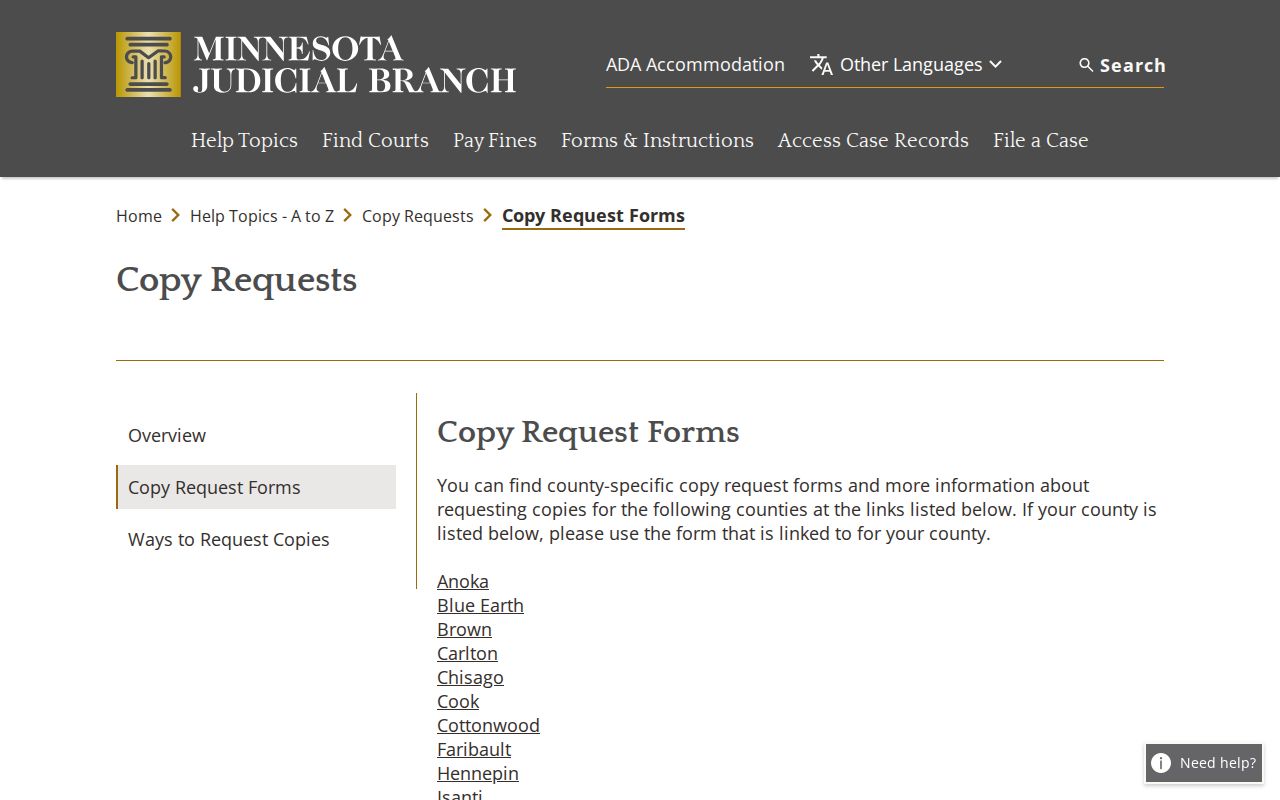
Martin County Copy Request Form
The statewide form gives Martin County Court Administration what it needs to find a file. It also lets the office prepare the copy. The form asks for your contact details and case type. It wants the court file number if known, the parties, and a document description. It also asks for the copy type, number of copies, delivery choice, and payment information. No file number? Give as much case information as you can, including the county. Describe the record closely. A document name, an approximate date, or an ROA index cuts down confusion. Case-type choices on the form include Civil, Family, Criminal, Conciliation, and Juvenile. Probate or Guardianship, Conservatorship, and Mental Health is another choice. Leave unnecessary private data out of a public-facing request. The Minnesota copy-request forms page shows county routing. It also supplies the statewide materials for the request.
What a Court Record Contains
A public Martin County case detail can hold more than a docket title. It may list the case number, category, date filed, venue, judicial officer, status, and related cases. A citation number appears when applicable. The ROA then runs events in reverse chronological order. A public-document control appears where one exists. Remember that a certified copy comes from the court itself. Display fields alone will not do.
| Case Information | Case number, title, type, date filed, court location, judicial officer, status, flags, and related cases as publicly displayed. |
|---|---|
| Register of Actions | A chronological activity log of filings, hearings, orders, dispositions, and public document links when available. |
| Case Events | Event date, event name or description, document index number, and a document-view control when public. |
| Hearings | Upcoming and previous hearings. Compare an upcoming setting with the current calendar because schedules can change. |
| Dispositions | Case-specific outcomes such as a judgment, dismissal, settlement, plea, disposition, or sentencing field where shown. |
| Financial or Judgment Detail | Public fines, fees, payments, credits, judgment detail, and satisfaction information when available. |
If the record shows an upcoming hearing, check it against the current Martin daily calendar and the hearing notice. The calendar helps confirm a schedule. But it is not a certified record, and it can omit confidential or non-remotely accessible matters.
Martin County Plain and Certified Copies
Know what kind of Martin County copy you are asking for. A plain copy merely informs. The Martin fee schedule prices plain copies, prints, scans, and screen prints at $0, yet a plain MCRO view is still not a certified court record. Certification and a seal are what the court's copy process adds, and the copy form lets you state the exact type you need instead of assuming any printout carries official weight.
Exemplified copies add another layer of authentication. Martin lists certified and exemplified copies as separate line items, and a copy that is both certified and exemplified carries its own fee. Before mailing anything, ask Court Administration to confirm the document, its access status, and the copy type. Sealed or confidential material can call for identification, a court form, a legal basis, or a judge's authorization.
Certified Copies and Fees
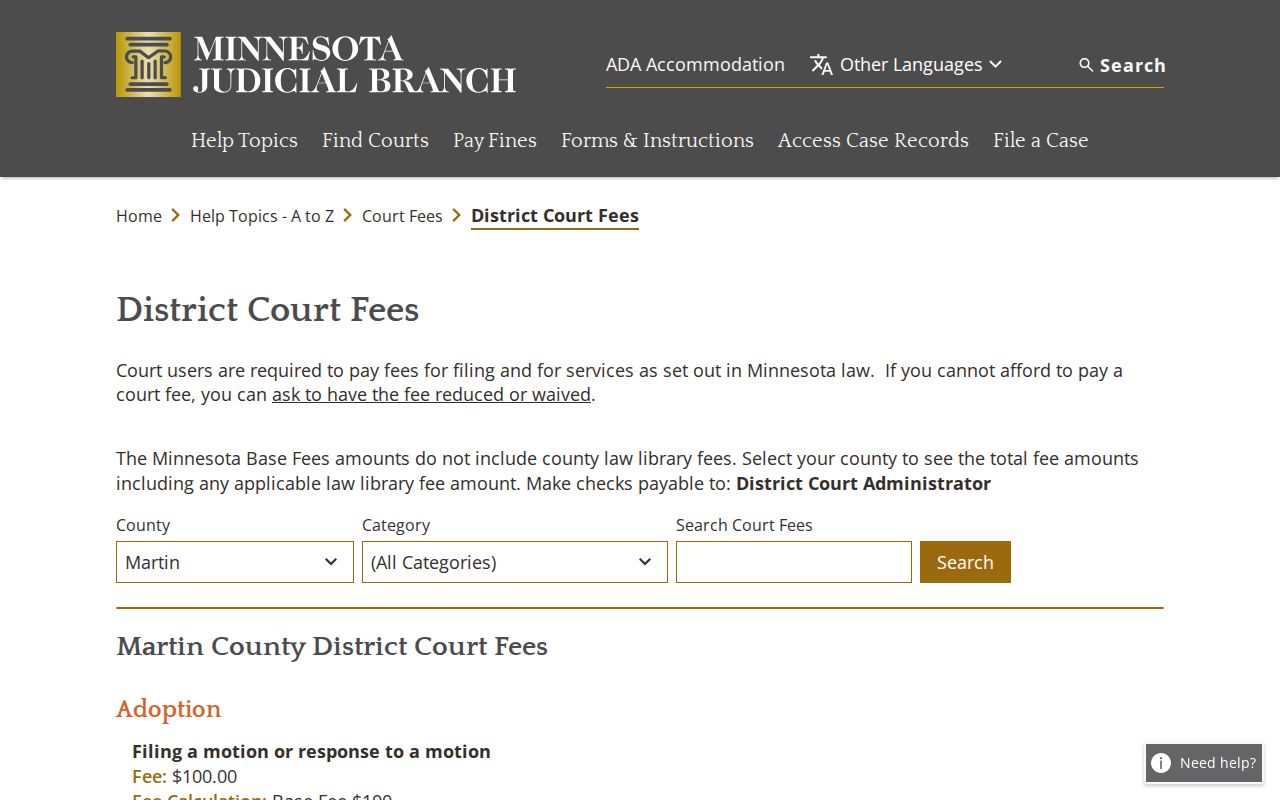
The Martin District Court fee schedule breaks out local copy and report charges row by row. Amounts shift over time, so verify the live schedule with Court Administration before counting on any figure. A certified-exemplified request and a plain screen print are different services with different prices.
| Item | Martin fee | Request note |
|---|---|---|
| Plain copy, print, scan, or screen print | $0 | Informational use; email and fax restrictions still apply. |
| Certified copy | $14 per document | Use the court copy process for an official copy. |
| Certified and exemplified copy | $28 per document | Both certifications are included. |
| Case-management report, 1 to 50 pages | $5 | The schedule lists a separate charge for larger reports. |
| Certified judgment search | $5 per name | Confirm the current calculation with Court Administration. |
Martin District Court's fee page lists the local fee categories.
Martin County Court Administration
Martin County Courthouse
201 Lake Avenue, Fairmont, MN 56031
507-432-7003
Martin County Record Fees Versus Filing Costs
Requesting a copy is not filing something new. Filing a complaint or motion through Minnesota eFile and eServe may trigger a filing fee plus court processing. An allowed paper route can do the same. Copying an already-filed record is different. That path runs through MCRO, MPA, or the copy-request process. Only the copy, certification, report, or search fee attaches.
The Martin fee schedule mixes filing and record services on one page. Read the item description closely. A filing-related scan, for instance, is not the general document-copy price. Say which document you need and whether certification matters before Court Administration calculates your Martin County court-record request.
Martin County Record Delivery Choices
Delivery choices on the statewide request form cover U.S. Mail, pickup, fax, and email. A prepaid FedEx or UPS label is another option. Plain, non-confidential copies are the only ones marked for email and fax. Certified and exemplified requests take a credit card. Or pay by check or money order made out to the District Court Administrator, following current court instructions.
Same-day service applies to many in-person copies. Still, no universal promise exists. An offsite record can lag, and the form gives no fixed turnaround. Call ahead before mailing anything complicated or confidential. Court Administration will say whether a record needs a different route.
Public Access and Sealed Records
Minnesota sorts court-record access into tiers. A file can be open for inspection at the courthouse yet absent from MCRO, or the ROA shows while certain documents stay offline. Protection-order, harassment, CHIPS, public civil-commitment, and some juvenile records demand special handling. Closing a case does not expunge it. A missing result never proves the case never existed.
Minnesota court-record rules. Rule 8 governs public access and distinguishes courthouse access from remote display.
Rule 4 identifies non-public and restricted records, including protected proceedings.
Minnesota Statutes section 13.90 directs judicial-record access through Supreme Court rules instead of a general county data-practices request.
Minnesota Statutes section 485.07 identifies the register of actions, judgment roll, judgment docket, and indexes maintained by the court administrator.
Martin County Restricted Record Questions
Sealed, confidential, or remotely unavailable records call for an answer tied to that court. The local court administrator can tell you whether a request needs identification, an extra form, a stated legal basis, or judicial authorization. Money does not unlock a restriction. A remote search result also cannot settle whether a protected file is available to you.
Juvenile, protection-order, harassment, CHIPS, and public civil-commitment matters should follow the current rule and court instruction before any request goes out. Keep personal identifiers from a restricted case out of public search examples and out of mailed requests that do not need them.
Martin County Judicial Record Route
A Martin County record may fail to turn up remotely. When it does, write down your search terms, county filter, case category, date range, and the search date. Then pick the channel that fits: courthouse, phone, or copy request. MCRO's electronic data is not the official court record. Errors and omissions happen, so certified results still require the court's copy process.
Rule 8 plus the case-specific access rule govern the next lawful step. Court Administration can walk you through the process. But a copy fee never buys a general right to confidential material. Expect identity verification, a form, a legal basis, or authorization for restricted requests.Note: A strong request names the court. It also names the known case information, the exact document, the copy type, the delivery method, and your contact details.