
How to Search Martin County Criminal Dockets
For most people, Minnesota Court Records Online is the fastest route into an eligible Martin County criminal case. Accept the terms and choose Case Search. Then pick a search mode that matches what you know. One caution applies. MCRO is a public view, not the certified record. Its case detail can open the Register of Actions, or ROA. That is the running log Minnesota uses. It stands in for a plain docket sheet.
Name search works when spelling is exact. It will not catch every pending criminal, traffic, or petty-misdemeanor matter. With a known case, a case number, citation number, or attorney search often works better. Pick Martin from the county-location control for local results. Then open the right case number and read the ROA by date. For certified records, copy questions, or an access problem MCRO cannot fix, contact the Martin County District Court office.
- Open MCRO, accept its terms, and select the Case Search tab.
- Choose Name, Case Number, Citation Number, or Attorney, then add the Martin County location filter when appropriate.
- Narrow a name result with the available filed-date, category, or status controls rather than assuming the first result is the right case.
- Open View Case Details and read the ROA, hearings, charges, and disposition entries together.
- Use Martin County Court Administration for an eligible courthouse search, a copy request, or a certified record.
Note: A remote result can leave out protected information or documents even when parts of the court file are public.
Martin Criminal Case Number Format
Minnesota case numbers usually blend a two-digit county code, case-type letters, a two-digit year, and a sequence. Martin County carries the county prefix 46. A criminal sample looks like 46-CR-26-.... Treat that as a format illustration only, not a live case number. A full case number is the sharpest key for MCRO or a courthouse terminal. It points at one case instead of a crowd of similar names.
Once a case is filed, case-number search accepts that identifier. All criminal filings and court events live in the unified Martin County District Court system. There is no separate county criminal court or city portal. A citation can carry its own identifier. Traffic and petty matters may need citation search instead. The MCRO quick reference lists every search mode and filter.
What a Martin County Criminal Docket Shows
Case detail sorts public information into clear record areas. The ROA runs newest entry first. Still, read the activity log together with the charge, hearing, and disposition portions; a status label alone is not the whole result. Remember that a charge is a filed allegation or count. It is not a conviction.
| Case information | Case number, case type, date filed, Martin County venue, judicial officer, status, flags, citation number, and related cases when displayed. |
|---|---|
| Charges and warrants | Public charge and warrant-status material for eligible criminal cases. A charge does not decide guilt. |
| Case events | Event date, description, document index number, and a View Document control when a public document is available. |
| Hearings | Upcoming and prior settings, which should be checked against the current court calendar or hearing notice. |
| Disposition and sentence | Plea, disposition, sentencing, and related financial or bond information where the public record displays it. |
The official MCRO case-details handout separates financial information and judgment details from a certified court record. That line matters whenever your document needs the court's certification.
Note: The newest ROA event may only describe a setting or filing, not the final resolution of a Martin criminal case.
Martin Criminal Calendar and ROA
Think of a Martin criminal calendar as a schedule, not a record. The daily calendar can list a public hearing date, time, hearing type, judicial officer, connection type, location, and case number. It changes often. It also skips confidential or non-remotely accessible matters. A setting on the calendar proves nothing about dismissal, conviction, or sentence.
The ROA answers the different question of what the court recorded in the case. A criminal matter can move through Filing → Arraignment → Pretrial → Plea or Trial → Disposition → Sentencing. The actual case events and any public underlying document provide the reliable way to distinguish those stages. For a current connection method, follow the hearing notice and local instructions, not an older calendar line or general meeting information.
Minnesota remote-hearing information from the Judicial Branch explains how hearing instructions are published.
For any Martin criminal docket setting, the individual notice and court direction decide whether the hearing is remote, hybrid, or in person.
Stages on a Martin County Criminal Docket
A Martin County criminal docket often opens with a filing or initial appearance. Arraignment and pretrial activity follow. Later entries may show an omnibus hearing, motion hearing, plea, trial, sentencing, review, or another setting. The name of an event tells you its type only. It never states the result. Before drawing any conclusion about a case, look for the event sequence. Check the disposition field too. Add any public order on file.
Bond or bail activity, interim conditions, and financial entries can show up in case-detail sections for eligible records. Where they appear, those fields describe court-record activity. They do not replace a case disposition or a certified judgment. Closing a matter is one thing. An order granting expungement or sealing is another.
Martin Criminal Name Search Limits
One MCRO limit matters for any Martin County criminal docket search. A case that is still open may not show up when you search by defendant name. That applies when no conviction has been entered yet. That covers criminal, traffic, and petty-misdemeanor files. So an empty result does not mean no citation or filing exists. Write down the spelling you used, the Martin County filter, the case category, the date range, and the search date. Then switch to a case number, a citation number, or an attorney search if you can. The right tool helps too. MCRO gives you separate tabs for Case Search.
Search result caution: “No result located” describes the search performed. It does not prove that Martin County has no court record.
Which Martin County Court Holds Criminal Dockets
Martin County District Court handles every criminal docket in the county. Felonies, misdemeanors, and traffic tickets all land in one place. Any ticket that reaches a judge comes here too. Minnesota keeps no separate county criminal court or municipal portal here. Martin sits in the Fifth Judicial District. District staff do not manage an individual county file.
Court Administration is the office to call. It keeps the Martin County court record, answers case questions, and issues certified copies. The courthouse sits at 201 Lake Avenue in Fairmont. The official court page lists 507-432-7003. Federal cases are a different system entirely. They never appear in a Martin County criminal docket search.
Want the setting for your docket search? The Martin County Courthouse history page traces the building that still houses the district court. Its records remain there today.
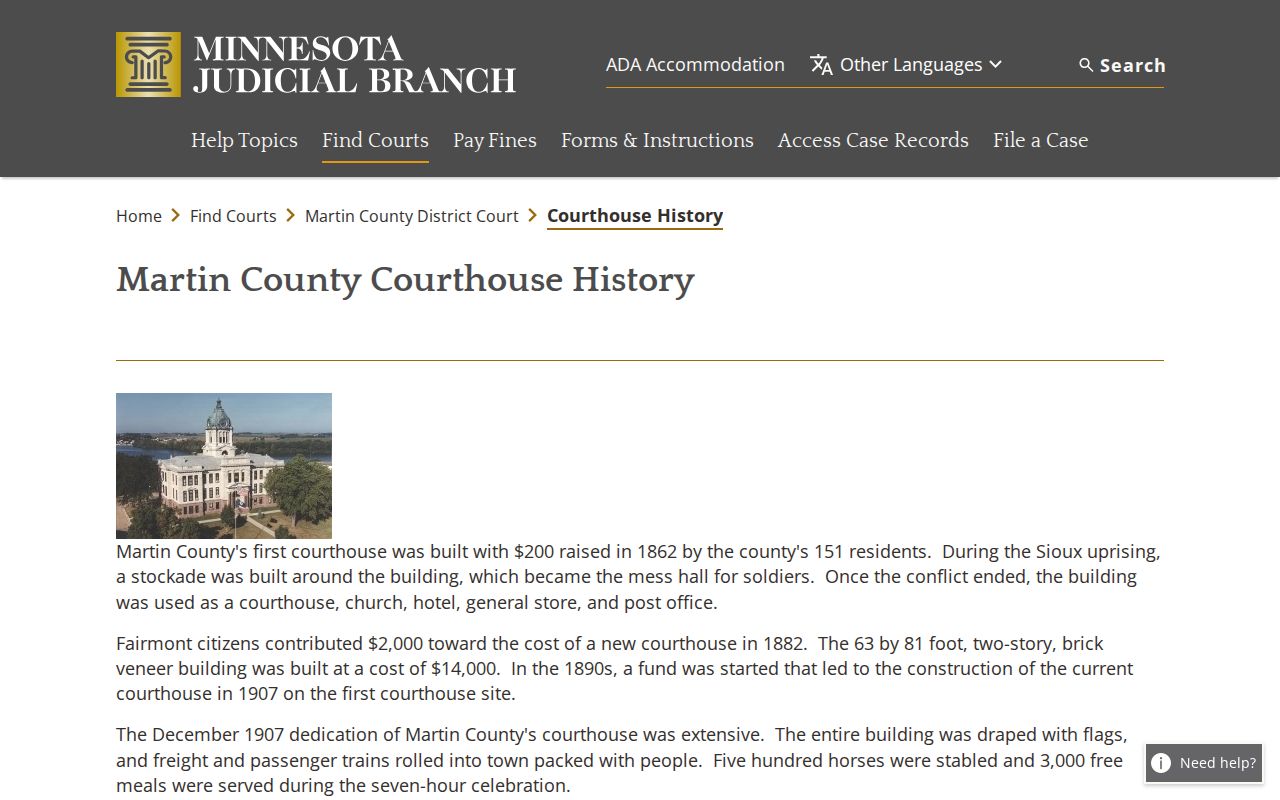
The old building does not shift the modern split of duties. MCRO serves remote public research, while Court Administration keeps the official local file.
Martin Criminal Documents After 2015
Remote access runs in tiers, set by case type, document type, and filing date. Under the Minnesota accessible-documents guidance, papers filed after July 1, 2015 are broadly available in major and minor criminal cases. The rules and individual restrictions still apply. Broad is not the same as complete. A Martin criminal file can show its ROA while a particular document stays withheld. Older records come with narrower remote categories. The courthouse layer is MPA, Minnesota Public Access Courthouse View. It can give a fuller eligible statewide view than MCRO. Rule 8 and other limits still apply. Criminal, traffic, and petty searches at MPA offer Case, Defendant, Citation, and Attorney routes. The Case route prefers a complete case number. A citation route wants the full citation number with no dashes or spaces. Note: a courthouse-terminal record still answers to judicial-record access rules. It never makes confidential material public.
Public Access and Sealed Martin Criminal Dockets
Minnesota public access follows court-specific rules. It is not a general county records request. The Register of Actions and the public calendars are their own record categories. Remote display can still leave out protected data and nonpublic case material. Juvenile records answer to distinct access rules. Sealing or expungement is not the same thing as a routine closed status. And a missing result is never proof that a case did not exist.
Access rules for Martin criminal records:
Rule 8 provides public court-record access while distinguishing courthouse inspection from remote access and protecting specified data.
Rule 4 identifies nonpublic and restricted case records, including protected proceedings at specified stages.
Minnesota Statutes § 13.90 directs judicial-record access through Supreme Court rules instead of the general Data Practices Act route.
Minnesota Statutes § 609A.02 supplies statutory grounds for an expungement order; the court order controls access.
Need a restricted or certified copy? Contact Martin County Court Administration in person, by phone, or through the statewide copy-request process. The request form allows mail, pick-up, email, or fax for eligible plain, non-confidential copies. Certified and restricted requests can require extra review. Filing a case is a different act from asking for a record. Minnesota eFile and eServe is the filing and service system. It is not the public docket viewer. Note: the court administrator can explain the access route but cannot lift an access restriction through a routine request.
Martin Criminal Copy and Court Access
MCRO sometimes will not hand back your record. Martin County Court Administration is the local access path. Bring or provide the case number if you can. If it is unknown, the Minnesota copy-request guidance asks for as much county, party, case-type, and date detail as possible. A request can spell out the document, a date or ROA index, the copy type, the delivery method, and the number of copies. MCRO printouts are not certified. The Martin fee schedule lists $14 for a certified copy and explains additional certified or exemplified rows. Most in-person copy requests finish the same day, though offsite records can take longer. Call ahead for a confidential, sealed, complex, or older record. Then the court can state the lawful route and the current fee.